

The latest market picture is uneven, rather than a uniform collapse: US stocks finished 12 November modestly lower, while the latest daily euro reference rate also weakened against the dollar. Inflation and financing costs help explain why investors are sensitive to new developments. They do not establish a single cause for every market move.
This morning briefing was checked on 13 November 2026. The US equity figures refer to the completed 12 November session. The currency figures are daily references for 11 and 12 November, not live prices for this morning. Different markets close at different times.
What the latest completed sessions show
Associated Press reported declines of approximately 0.4% for the S&P 500, Dow and Nasdaq on Thursday. The practical distinction is important: an abrupt move in one company or during part of a session does not equal the final performance of an entire index.
The ECB-based daily reference observations available through Frankfurter put one euro at $1.1081 on 12 November, compared with $1.1127 on 11 November. That is a decline of approximately 0.41% in EUR/USD between these two reference observations.
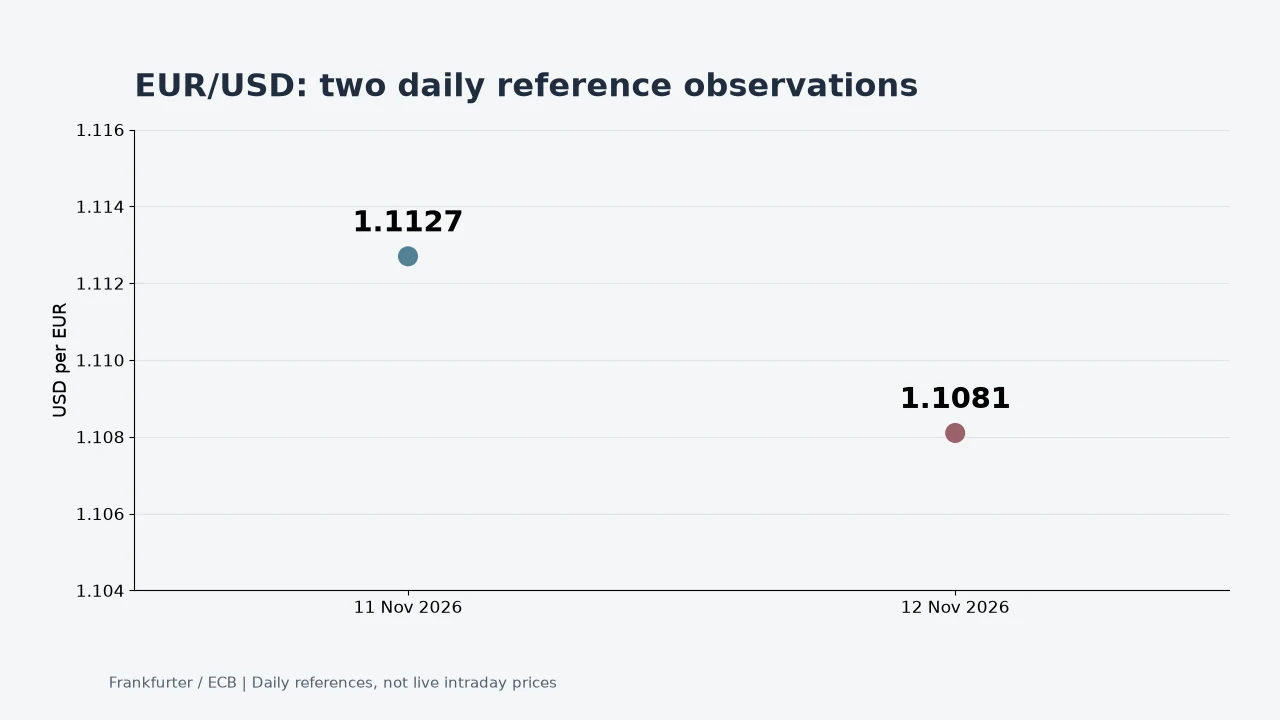
| Reference observation | 11 November | 12 November |
|---|---|---|
| USD for 1 EUR | 1.1127 | 1.1081 |
| GBP for 1 EUR | 0.83618 | 0.83595 |
| JPY for 1 EUR | 177.18 | 176.96 |
Why inflation matters to exchange rates
The BLS reported a 0.4% monthly rise in US consumer prices in October. Inflation can influence expectations for interest rates. If investors expect comparatively attractive returns on dollar assets, that can support demand for the currency. The actual exchange rate still depends on expectations in both economies and on what markets had already priced in.
A plausible channel, not a proven single trigger
Higher expected financing costs can make investors less willing to hold volatile assets. That does not guarantee a stronger dollar against every currency. Trade flows, central-bank policy and changes in demand for safer holdings can pull exchange rates in different directions. One EUR/USD observation cannot establish a global dollar trend.
What a small move means for a real payment
For an illustrative €1,000 conversion, the first reference gives $1,112.70 and the second gives $1,108.10. The difference is $4.60 before charges. A provider's fee or exchange-rate markup can exceed that daily difference, so the market headline is only part of the cost.
Ask for the final amount the recipient will get. Compare that amount at the same time and for the same payment method. A percentage rate improvement can be offset by a flat transfer charge.
- Use 1,000 EUR to USD to calculate an amount.
- Check the reverse direction with 1,000 USD to EUR.
- Compare a different route using 1,000 EUR to GBP.
What to watch next without chasing every headline
Look for the next dated reference observation and the actual quote from your provider. Watch whether interest-rate expectations change, while keeping completed equity sessions separate from live currency trading. No scheduled policy outcome or next-day exchange rate is certain from today's information.
Why a daily converter may differ from your bank
Daily reference data describe an observation, not a guaranteed tradable price. Banks add spreads and sometimes fees, while card settlement may occur later. A reference converter is useful for checking scale and arithmetic; the provider's final payable amount remains essential.
Sources and observation dates
TRY THE PAIRS IN THIS GUIDE
Currency conversions from this article
The examples in the text are for learning. These cards use our latest available daily reference rates.


EUR to USD
Euro to United States Dollar
1000 EUR ≈
1,098.78 USD
1 EUR = 1.09878035 USD
Rate date:
Open converter ↗USD to EUR
United States Dollar to Euro
1000 USD ≈
910.10 EUR
1 USD = 0.9101 EUR
Rate date:
Open converter ↗
EUR to GBP
Euro to British Pound
1000 EUR ≈
837.71 GBP
1 EUR = 0.83771014 GBP
Rate date:
Open converter ↗Source: Frankfurter daily reference data. Bank, card and transfer fees are excluded. How rates are calculated →



 ZWG → USD
 GYD → USD
 GMD → USD
 JOD → USD
 BRL → USD
 PKR → USD